Self Leveling 4D Laser Level Explained: A UK Buyer's Guide
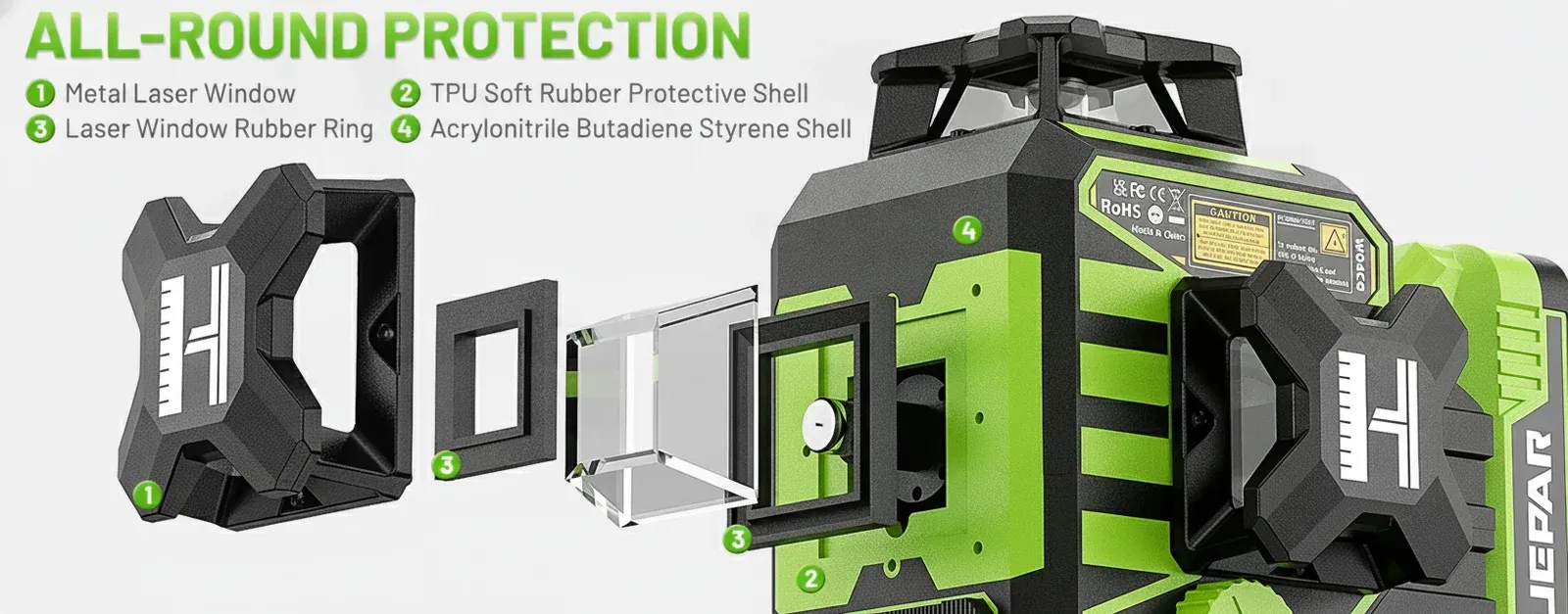
TL;DR: A self leveling 4d laser level projects four 360° laser planes and automatically levels itself, helping UK tradespeople set out walls, floors and ceilings faster and more accurately. In short, it is best suited to fit-out, tiling, kitchens, studwork and ceiling work where full-room coverage reduces repositioning and costly mistakes.
A self leveling 4d laser level is a multi-line layout tool that automatically finds level and projects four 360° reference planes for faster, more accurate set-out across walls, floors and ceilings. For UK tradespeople, this means less time checking marks manually with spirit levels and chalk lines, and more confidence that units, tracks, tiles and ceiling lines will line up properly first time.
At LevelGrid, the focus is simple: dependable layout tools for real British site conditions. Based on our testing on indoor fit-out tasks such as kitchen installation, partition layout and floor-to-ceiling alignment checks, the main advantage of a 4D self-levelling model is straightforward: it gives broader coverage with fewer interruptions.
Key Takeaways
- A self leveling 4d laser level projects four 360° laser planes to cover horizontal and vertical layout tasks in one tool.
- Self-levelling saves time and reduces human error compared with manual levelling methods.
- Green beam models are typically easier to see indoors than red beam alternatives, especially on bright UK fit-out jobs.
- The best choice for UK buyers depends on accuracy, range, battery platform, mounting options, durability and aftersales support.
- For broader technical background, see The Ultimate Guide to 360 Degree 4D Laser Level in the UK.
What is a self leveling 4d laser level?
A self leveling 4d laser level is a precision layout tool designed to project multiple full-room reference lines without constant manual adjustment. In practical terms, “4D” usually refers to four separate 360° laser planes: commonly two horizontal lines and two vertical lines. As a result, you get near-total coverage around a room and across different surfaces from one setup point.
The self-levelling element matters just as much as the number of beams. Instead of relying on the user to centre a bubble vial by hand, the internal pendulum or motorised compensator automatically settles within a defined levelling range. If the tool sits outside that range, it will usually flash or sound an alert to show it is no longer level.
For UK tradespeople working against tight programmes, this combination is useful because it turns one compact device into a layout reference for:
- walls
- floors
- ceilings
- partitioning
- tiling set-out
- suspended ceiling alignment
- socket and switch positioning
- kitchen installation
- door frame checks
If you want a broader overview of how multi-plane tools fit into modern site work, our pillar guide covers the fundamentals in more detail: The Ultimate Guide to 360 Degree 4D Laser Level in the UK.
How does a self leveling 4d laser level work?
A self-levelling laser level uses an internal compensator system that automatically adjusts the projected line until it is level or plumb. On most professional-grade units, this works within a limited range such as ±3° or similar. Therefore, once placed on a reasonably stable surface or mount, the device corrects itself far more quickly than manual methods.
How do pendulum-based self-levelling systems work?
Many site lasers use a pendulum mechanism suspended internally. Once unlocked, gravity allows it to settle into level. This design is popular because it is quick and reliable for common indoor construction and fit-out tasks.
What happens if the laser level is out of level?
If the unit is set too far off true level, most self-leveling models will flash their beams or trigger an audible warning. Consequently, this helps prevent inaccurate marking before work begins.
Can you use manual mode for angled work?
A good self leveling 4d laser level will often include manual mode for angled applications such as stair runs or feature installations where true horizontal or vertical lines are not wanted. However, for standard layout work, auto levelling is what gives users speed and consistency.
Why choose a self leveling 4d laser level over a standard line laser?
A standard cross-line laser can be perfectly adequate for light domestic jobs. However, the reason many professionals step up to a self leveling 4d laser level is coverage. Four full-plane beams reduce repositioning and allow you to transfer reference points around the room with fewer interruptions.
Does 4D coverage make room-wide set-out easier?
With true 360° projection, one setup can create continuous reference lines on multiple surfaces at once. That matters when aligning floor tracks with ceiling channels or checking whether wall runs stay consistent through corners.
Does less repositioning save time on site?
The more often you have to move a tool, the greater the chance of introducing error or wasting time re-establishing datum points. So, a 4D model helps maintain continuity throughout the task.
h3>Easier coordination between tradesOn busy UK jobs where dryliners, electricians, tilers and kitchen installers may all depend on reliable lines، broad beam coverage can make collaboration simpler. In other words، everyone can see the same references without waiting for fresh marks to be taken manually. < section>> >If beam visibility matters high on your checklist,,ाव then it is also worth reading our dedicated article on green visibility advantages:adopt:
Green Beam Beam12D Laser Level Explained: A UK Buyer's Guide.This
هㅠ
assistant Ready to upgrade your layout speed with LevelGrid?